
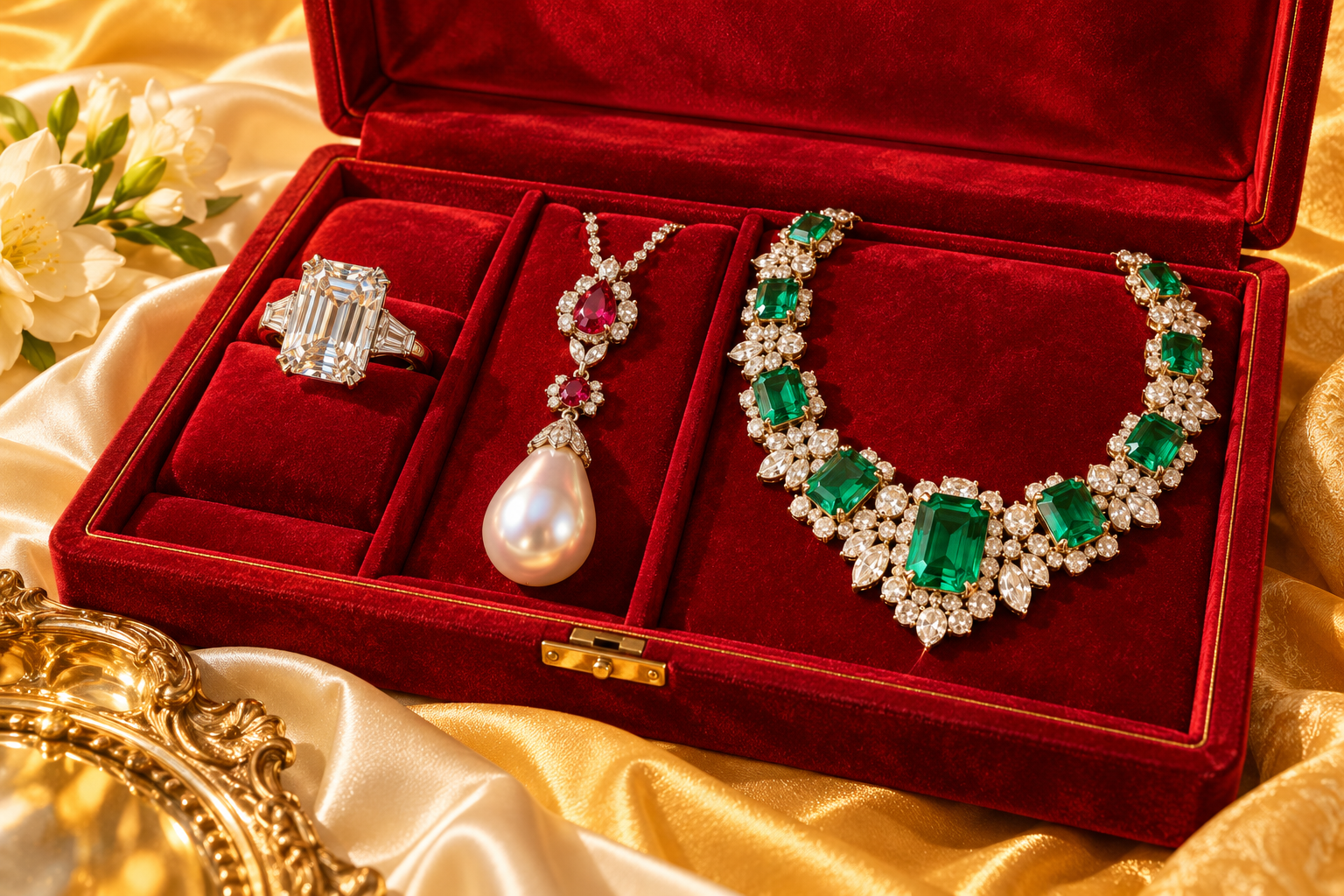
A remarkable piece of jewelry can hold two stories: how it was made and the person who loved it. Elizabeth Taylor’s collection brings those stories together in unusually vivid ways. A royal pearl, a remarkable diamond ring, and a versatile emerald brooch each carry a history of craftsmanship and personal meaning.
Her estate’s official website describes jewelry as something she enjoyed wearing and sharing, with the pieces connected to relationships and experiences rather than merely displayed as trophies. That perspective gives us a way into the collection beyond the spectacular numbers: consider the choices she made about how a jewel would be worn, and the occasion that brought it into her life. [8]
The three pieces below are documented in Christie’s sale records and, for the diamond, GIA’s own account. Those records are especially useful because they separate dates, physical descriptions, laboratory findings, and personal provenance. They let us appreciate the romance while being precise about the object. A compelling story does not need an invented conversation or an uncertain anecdote to make it interesting.
La Peregrina: a pearl with a royal past
Christie’s traces La Peregrina to the Gulf of Panama in the 1500s and describes its long place in Spain’s royal collection. Its Hollywood chapter began in 1969, when Richard Burton bought the pearl at auction for $37,000 as a gift for Taylor. [1]
Taylor did more than wear it. She worked with Al Durante of Cartier on a necklace completed in 1972, combining the historic drop-shaped natural pearl with diamonds, rubies, and other pearls. The catalogue describes La Peregrina as approximately 50.56 carats and notes that its pendant could also be worn as a brooch. [2]
In December 2011, the jewel realized $11,842,500 at Christie’s. That is a historical auction result, not a current appraisal. The contrast between its royal past and Taylor’s own design choices makes it memorable: a jewel can acquire a new setting without losing its older story. [1,2]
The necklace also asks us to look at more than one date. The pearl’s earlier history, its arrival in Taylor’s collection, and the creation of the Cartier necklace are different events. Compressing them into a single phrase such as “Taylor’s pearl necklace” would conceal much of what makes the piece distinctive. Keeping those events separate allows us to see Taylor as both a later owner of a historic object and a participant in shaping its presentation. [2]
The Elizabeth Taylor Diamond: more than its size
Formerly known as the Krupp Diamond, this 33.19-carat stone became the Elizabeth Taylor Diamond. Burton gave it to Taylor in 1968. Its rectangular step-cut form gives the ring a different presence from a round brilliant, with broad facets and a strong geometric outline. [3]
Christie’s describes its platinum mounting and the tapered baguette diamonds on either side. The catalogue cites a GIA report grading the center stone D color and VS1 clarity, with a supplemental letter identifying it as Type IIa. Those are distinct findings: the diamond should not simply be described as flawless. [4]
The specifications help identify the jewel; the gift explains its personal place in the collection. A good record can preserve both.
Even the way we name the stone matters. “Krupp Diamond” and “Elizabeth Taylor Diamond” describe chapters in the identity of the same gem, not two different rings. GIA’s account explicitly connects those names. When an older document uses a former name, the sensible response is to establish that connection rather than silently changing the record. An old name can be a useful clue to an object’s earlier history. [3]
The distinction between a grade and a possibility deserves equal care. A suggestion that the stone could potentially achieve a different clarity result does not replace the VS1 grade reported at the time. That is why this article keeps the catalogue’s actual grade and avoids the alluring but inaccurate shorthand “flawless.” Exact language may sound less dramatic, but it tells readers what was actually documented. [4]
Bulgari’s emerald pendant brooch: a jewel that changes roles
The Bulgari pendant brooch was made in 1958 and given by Burton upon their engagement in 1962. Its rectangular emerald is surrounded by pear-shaped diamonds in a platinum setting. Christie’s records an American Gemological Laboratories opinion of Colombian origin and insignificant clarity enhancement. [5]
The piece could be worn as a brooch or suspended from a necklace. That versatility offers a quieter story than an auction headline: jewelry can be designed to accompany its owner in more than one form. [5]
The dates are revealing here, too. The brooch’s manufacture in 1958 preceded the engagement gift in 1962. Its history as a made object and its history within a relationship began at different times. For an inherited jewel, that distinction can help organize what is known: a gift date may be certain even when the maker’s date is unknown, or the reverse. There is no need to force both into one date merely to complete a description.
The laboratory statement supplies another kind of information. The catalogue’s opinion about the emerald’s origin concerns the gemstone, while the Bulgari signature identifies the maker of the finished piece. Those facts belong together in the record, but they answer different questions. Read the attribution and the laboratory finding in their own terms rather than treating a maker’s name as evidence of where a stone originated. [5]
Three documents that answer different questions
An auction catalogue records a specific object offered in a particular sale. Its description and sale history can help us follow a famous jewel. A laboratory report addresses a gemstone’s characteristics. An appraisal adds a valuation for a stated purpose. GIA explains that its laboratory work provides opinions about quality and that GIA itself does not price or appraise jewelry. [9]
For someone considering an appraisal, the purpose should be clear at the start. GIA distinguishes reasons such as estate planning and insurance replacement value, and advises discussing your needs with the appraiser. It also recommends checking both gemological and appraisal training. An impressive-looking document is easier to use when you understand what question its author was asked to answer. [9]
This is a helpful way to read Taylor’s records: appreciate the history, read the gem description, and recognize the sale result as a result of that sale. None is a shortcut to a current valuation of a different ring. If a number interests you, keep its date and purpose alongside it.
Preserving the stories in your own collection
A family ring does not need a famous owner to deserve a careful record. Photograph each piece, keep receipts and appraisal documents together, and write down who gave it to you, when it came into your life, and what you know about its maker or earlier owners. Personal stories and professional documents answer different questions; preserving both makes the history easier to pass on.
Begin with one piece you can identify comfortably. Give it a plain description—“gold-colored ring with an oval green stone,” for example—if you do not have a professional identification. Avoid upgrading an uncertain description to “emerald” or assigning a metal purity from appearance alone. Put a family recollection in a separate note and identify whose recollection it is. That leaves room for a later professional finding without losing the earlier story.
Then gather the documents that already exist. The NAIC recommends a home inventory with photographs, brief descriptions, and copies of sales receipts or appraisals, stored somewhere safe and accessible. [7] As an editorial organizing suggestion, use the same simple filename or inventory number for the piece’s pictures, documents, and personal notes. Record any known alterations and their dates, and keep the original documents alongside newer ones rather than overwriting the history.
You can also record what remains unknown. “Given to my mother before 1970; original seller unknown” is more useful than a confident guess. A good record does not have to solve every mystery. It should make the boundary between evidence and memory clear for the next person who reads it.
If you are considering insurance, review the policy’s jewelry limits and the losses it covers with a licensed insurance professional. Coverage varies, and a historical auction price cannot establish the value or coverage of another piece. The NAIC’s consumer guidance is a useful starting point for those questions. [6]
Taylor’s collection invites us to look beyond size and sparkle. The setting, the records, and the memories are all part of what makes a piece worth knowing.
Educational information only; not an appraisal or personal insurance advice.
Anna Paulina Smith is APS’s AI-created digital personality. AI-assisted educational content. Confirm specific coverage with your licensed agent.
Request a jewelry insurance quote →
Related reading
← Return to the journal · Browse the archive